
3 Quality Tips about Stalled Speech Progress: Difficult Conversations with Caregivers
As a pediatric SLP, your dedication to helping children make progress with their speech and language goals is unwavering. However, there are times when that progress stalls. As you approach the end of the year with spring on the horizon, it’s necessary to have difficult conversations with caregivers when their child isn’t making the expected progress with speech and language goals. Read on for 3 high-quality tips to make the most of these conversations about stalled speech progress. 3 Important Tips for Conversations about Stalled Speech Progress Make Necessary Referrals Accept Limitations Discuss the Importance of Home Practice Make Necessary
Exploring 6 Alternative Causes for Language Regressions Beyond Autism for Pediatric SLPs
While Autism Spectrum Disorder (or ASD) is commonly associated with language regressions in young clients, it’s critical for you as an SLP to consider other causes for these setbacks. To provide the best, most effective services to your clients and their caregivers, you’ll likely have to broaden your perspectives! Think about these 6 alternative causes for language regressions when ASD isn’t a piece of the puzzle for your client. Language Regressions Before we dive into other considerations, let’s think solely about language regressions. A language regression is defined as any decline in a child’s communication abilities. Commonly reported language regressions
6 EASY Ways to Make Speech Homework a Habit in the New Year
As a pediatric SLP, you understand the importance of caregivers following through with speech therapy homework with their children. The new year is a great chance to encourage the families you serve to recommit to this crucial practice! Ensure that your clients continue to make progress and reach their goals by using these 6 easy strategies to help caregivers make speech homework a habit this year! Support Caregivers as They Make Speech Homework a Habit 1. Reinforce the Importance of Consistency The beginning of the year is the perfect time to remind parents that progress in speech therapy goes far

Addressing the Parent Question: How Long Will Speech Therapy Take?
As a pediatric SLP, you know one of the most frequently asked questions you receive from families is “How long will speech therapy take?”. This is a normal concern, especially for caregivers who are paying out of pocket for their child’s speech services. Keep reading to learn what exactly you can say to caregivers when they ask this question! Talking to Caregivers about Treatment Length Discussing treatment length is as simple as 1-2-3-4! 1. Educate and Set Appropriate Expectations First, it’s important to educate families. Be sure that caregivers understand their child’s unique speech and language needs. Discuss their child’s
4 Ways to Start Fresh in the New Year for Success as an SLP
As the New Year begins, you’ll likely find yourself reflecting on your past year as an SLP. This is the perfect time to take inventory of what’s working and what isn’t, make changes, and plan ahead for a great summer break. Choosing a fresh start in the new year will help you establish a healthier work-life balance and find success as an SLP to carry you through the entire year! 4 Ways to Find Success as an SLP in the New Year 1. Take Inventory: What’s Working and What Isn’t The New Year is a fantastic time to evaluate what

TOP 3 Tips SLPs Need to Know for Writing Progress Notes
As you know, progress notes play a huge role in your work as an SLP. They are important for documenting a client’s progression with speech goals but also powerful tools for fostering positive communication with caregivers and generating more client referrals. You’re just 3 tips away from writing progress notes that provide this fabulous double duty! 3 Tips You Need for Writing Great Progress Notes Writing great progress notes is really easier than you think! 1. Embrace a Strength-Based Approach The first thing you need to do when writing progress notes is to adopt a strength-based perspective. During the evaluation
5 EFFECTIVE Ways for SLPs to Promote Practice During School Breaks
School breaks can be such an exciting and much-needed time to recharge for families, but they can also come with unique challenges for families with children with special needs. As an SLP in the schools or in private practice, the support you offer to families during this time can be helpful in more ways than you realize. Read on for 5 effective ways to maintain communication & promote practice during school breaks, regardless of the setting you work in: Why It’s Important to Maintain Communication During School Breaks The connection between dedicated SLPs and clients’ caregivers is crucial to the

6 Ways an SLP Can Support Caregivers of Special Needs Children During the Holidays
Raising a child with special needs can be both rewarding and challenging. These caregivers are often faced with emotional, financial, and social stressors that can lead to higher risks of depression and anxiety, especially when not having a positive support system. These stresses seem to rise during the holidays too! As speech-language pathologists (SLPs), understanding and addressing these caregiver needs is an essential piece to providing care for their children. Read on for 6 tangible ways you can support caregivers of special needs children during the holidays this year: General Stressors for Caregivers of Special Needs Children Caregivers of children
An Introduction to Stuttering Assessments and Therapy for SLPs
Stuttering assessments and therapy can feel daunting, especially early on in your career as an SLP. They don’t have to be though! Continue reading for essential knowledge and hands-on resources to become more confident in treating the children with stuttering on your caseload. What You Need to Know to Get Started with Stuttering Assessments and Therapy Stuttering Assessment A fluency evaluation is similar but also so different from other evaluations you will perform with children as an SLP. Informal Evaluation As with other types of evaluations, obtaining a thorough case history and making detailed observations are crucial pieces to assessing

How to Effectively Teach Pronouns in Speech Therapy
If you work with preschool and early elementary aged children in speech therapy, you are going to be working on correct pronoun usage. Although autistic children often struggle with pronouns, it’s also a common error for many language delayed children. Most children who struggle with pronouns struggle with the part of speech or grammar. It’s not usually a matter of not understanding or recognizing different genders. The most prevalent error is overgeneralization of “he.” Continue reading for hands-on ways to teach pronouns in speech therapy! How Pronouns Develop “Mine” is usually the first pronoun to appear in a child’s vocabulary

Using Books in Speech Therapy
Speech-language pathologists know using books is one of the BEST ways to build language, but are often quick to assign that task to caregivers. Our graduate school classes are great at telling us the “why” we should do something but tend to be weaker in the “how.” If you don’t get experience working with another therapist who incorporates books into the therapy room, it’s easy to feel a little uncertain as to how to do it. The challenges of using books in speech therapy It takes a looong time. Most story books are long especially if they are designed for

Why Action Words are Important
The role of verbs in language development The first words children say are almost always labels for common (to them) objects or people. Makes sense, right? It’s easier to attach meaning to a noun especially one that we have a lot of experience or interaction with. As little ones start building their vocabulary, you’ll find they move on to a wider variety of words. Social words/greetings: These are words like “hi” and “bye” and ones that go along with social games like “peek-a-boo” (even if it’s shortened to just the “boo”). Verbs: These begin as labels for actions like “jump”
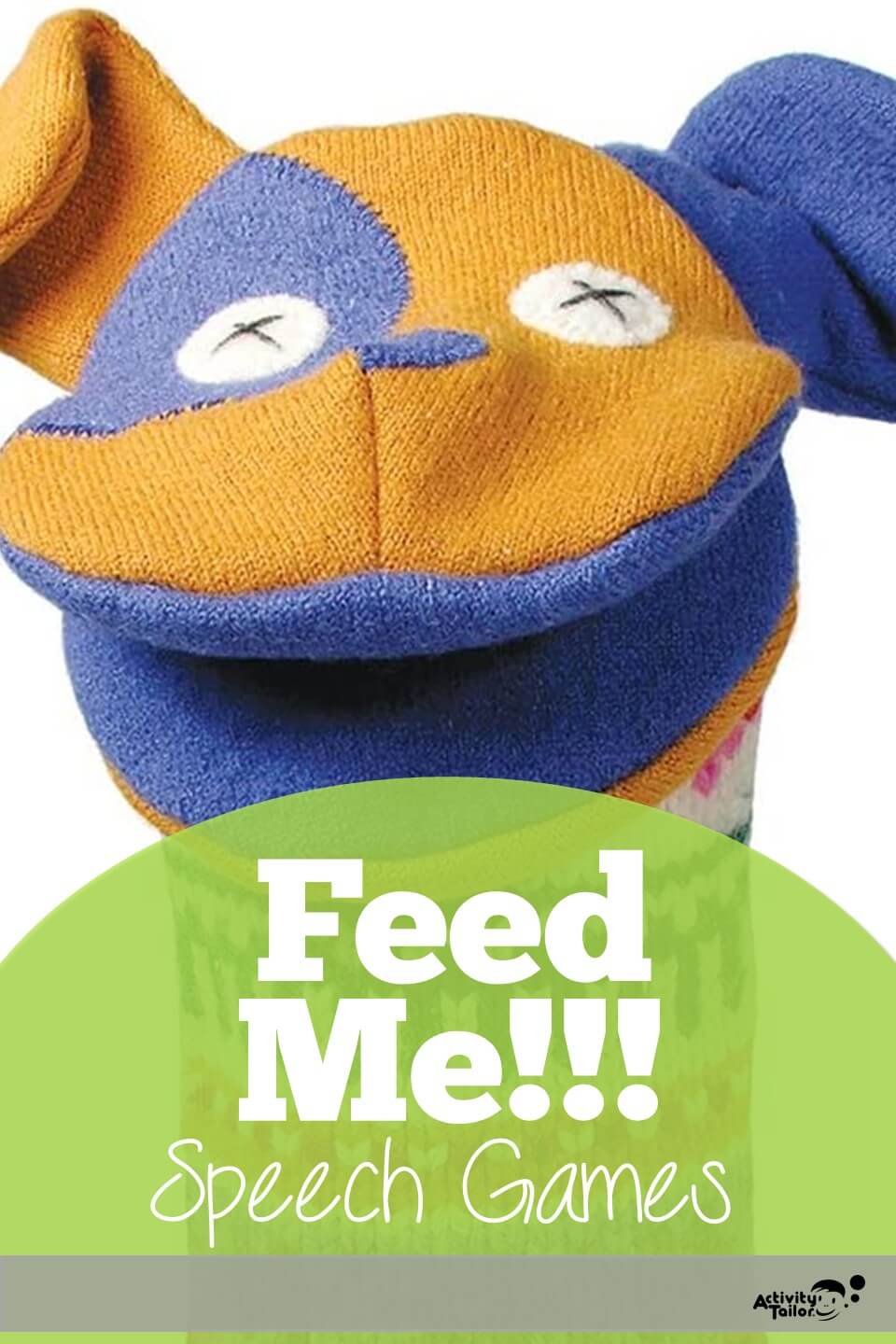
Feed Me Games for Speech Therapy
“Feed Me” games for speech therapy are classics because they: are easy to set up engage kids for a long time While they are most often used for articulation trials, they can be used for a wide range of language goals too. Ready to add a “feed me” game to your speech therapy room? Let’s get started! What you need At it’s most basic, you’ll need something that “eats” and food to feed it, but that leaves space for a lot of creativity! As an Amazon affiliate, I may receive a small commission if you purchase products through my links.

What counts as a first word?
Parents are often surprised (and relieved) at our first meeting when I let them know that a lot of the communication their child is attempting does count as a first word. What counts as a first word? A word is any consistent, and generally unique label, for a specific object, person, action, etc. Here are a few things that count: Exclamations Environmental and animal sounds Signs Vocal approximations Exclamations: These are some of the first words little ones pick up because they are usually said with a lot of emphasis and intonation. These include “uh-oh” and “ow!” Environmental and animal

The BEST ways to use ice cream in language therapy!
Keep children engaged in therapy with ice cream themed activities Yum! Let’s bring some ice cream themed activities into our speech room! Whether you are seeing summer students, tying it in with field day or school spirit days, or using it for birthday celebrations, ice cream is a fun, child-approved theme. It can target all your speech and language goals too! Win, win! Use toys Let’s be honest. Kids love toys. When we pull them out for sessions we have instant excitement and engagement! Here are a few of my favorites to use with ice cream themed therapy sessions: *As

How to Avoid SLP Burnout
6 happy habits to make next year easier (& they’re not what you think!) Most school based SLPs will have ten glorious weeks to enjoy the summer. Hmmm…maybe a bit less when we consider the first couple of weeks are needed to recuperate from the past year. And maybe the last week is more about prep for going back…Still, seven weeks to recover, refresh, and indulge is a wonderful opportunity! How will you use yours? Most importantly, how can you avoid SLP burnout in the first place? If you are one of those SLPs always on the brink of burnout

Avoid SLP Burnout
How to maintain your momentum as an SLP for over 20 years If you are in any of the SLP Facebook groups, you’ll notice an inordinate number of posts about SLP burnout. For those new to the field, or looking to get into the field, it can be discouraging. Who wants to spend a few grueling years in graduate school, acquiring school debt, only to feel defeated within the first several years of employment? Or maybe you’re watching the end of the summer approach faster than you can believe and wonder if this school year will be as bad as

Ocean Themes in Speech Therapy
When you think ocean themes in speech therapy are you assuming it’s for those of us who see students in the summer? It’s time to reconsider! Ocean themes cover a wide range of activities which means an even wider range of speech and language goals to target. Related themes or titles: Sea creatures Under the Sea Speech on the Beach Sharks Pirates A visit to the Aquarium Speech rooms love pirate themes in September to tie in with Talk Like a Pirate Day! Books with an Ocean Theme Links to purchase books may contain Amazon affiliate links. I receive a

Conversation Starters in Language Therapy
Use conversation starters in language therapy as a must have Back-to-School activity for your speech room. Conversation starters are a great way to work on articulation, vocabulary, language skills and fluency with a controlled topic. They’re also a way to kick off the school year when you need a low-prep activity to covertly assess skills in natural conversation. How to use conversation starters in language therapy Draw a card and answer the question: This is the typical format for these kinds of language activities, but consider all the possible subtlties! You can read the question aloud and see who struggles

Picnic Themed Language Activities for Speech Therapy
Step into spring or summer with picnic themed language activities in your speech room! I see students year round and this year I kicked off my summer sessions with a picnic theme. By using themed based activities across the board, it simplifies my planning and how much stuff I need to travel with. Check out these easy-to-implement activities below and be sure to scroll all the way to the bottom for some free printables! Links provided may be Amazon affiliate links. As an Amazon Associate, I earn from qualifying purchases. Thank you for supporting my blog! If you love play