3 Quality Tips about Stalled Speech Progress: Difficult Conversations with Caregivers
As a pediatric SLP, your dedication to helping children make progress with their speech and language goals is unwavering. However, there are times when that progress stalls. As you approach the end of the year with spring on the horizon, it’s necessary to have difficult conversations with caregivers when their child isn’t making the expected progress with speech and language goals. Read on for 3 high-quality tips to make the most of these conversations about stalled speech progress. 3 Important Tips for Conversations about Stalled Speech Progress Make Necessary Referrals Accept Limitations Discuss the Importance of Home Practice Make Necessary
Exploring 6 Alternative Causes for Language Regressions Beyond Autism for Pediatric SLPs
While Autism Spectrum Disorder (or ASD) is commonly associated with language regressions in young clients, it’s critical for you as an SLP to consider other causes for these setbacks. To provide the best, most effective services to your clients and their caregivers, you’ll likely have to broaden your perspectives! Think about these 6 alternative causes for language regressions when ASD isn’t a piece of the puzzle for your client. Language Regressions Before we dive into other considerations, let’s think solely about language regressions. A language regression is defined as any decline in a child’s communication abilities. Commonly reported language regressions
6 EASY Ways to Make Speech Homework a Habit in the New Year
As a pediatric SLP, you understand the importance of caregivers following through with speech therapy homework with their children. The new year is a great chance to encourage the families you serve to recommit to this crucial practice! Ensure that your clients continue to make progress and reach their goals by using these 6 easy strategies to help caregivers make speech homework a habit this year! Support Caregivers as They Make Speech Homework a Habit 1. Reinforce the Importance of Consistency The beginning of the year is the perfect time to remind parents that progress in speech therapy goes far

Addressing the Parent Question: How Long Will Speech Therapy Take?
As a pediatric SLP, you know one of the most frequently asked questions you receive from families is “How long will speech therapy take?”. This is a normal concern, especially for caregivers who are paying out of pocket for their child’s speech services. Keep reading to learn what exactly you can say to caregivers when they ask this question! Talking to Caregivers about Treatment Length Discussing treatment length is as simple as 1-2-3-4! 1. Educate and Set Appropriate Expectations First, it’s important to educate families. Be sure that caregivers understand their child’s unique speech and language needs. Discuss their child’s
4 Ways to Start Fresh in the New Year for Success as an SLP
As the New Year begins, you’ll likely find yourself reflecting on your past year as an SLP. This is the perfect time to take inventory of what’s working and what isn’t, make changes, and plan ahead for a great summer break. Choosing a fresh start in the new year will help you establish a healthier work-life balance and find success as an SLP to carry you through the entire year! 4 Ways to Find Success as an SLP in the New Year 1. Take Inventory: What’s Working and What Isn’t The New Year is a fantastic time to evaluate what

TOP 3 Tips SLPs Need to Know for Writing Progress Notes
As you know, progress notes play a huge role in your work as an SLP. They are important for documenting a client’s progression with speech goals but also powerful tools for fostering positive communication with caregivers and generating more client referrals. You’re just 3 tips away from writing progress notes that provide this fabulous double duty! 3 Tips You Need for Writing Great Progress Notes Writing great progress notes is really easier than you think! 1. Embrace a Strength-Based Approach The first thing you need to do when writing progress notes is to adopt a strength-based perspective. During the evaluation
5 EFFECTIVE Ways for SLPs to Promote Practice During School Breaks
School breaks can be such an exciting and much-needed time to recharge for families, but they can also come with unique challenges for families with children with special needs. As an SLP in the schools or in private practice, the support you offer to families during this time can be helpful in more ways than you realize. Read on for 5 effective ways to maintain communication & promote practice during school breaks, regardless of the setting you work in: Why It’s Important to Maintain Communication During School Breaks The connection between dedicated SLPs and clients’ caregivers is crucial to the

6 Ways an SLP Can Support Caregivers of Special Needs Children During the Holidays
Raising a child with special needs can be both rewarding and challenging. These caregivers are often faced with emotional, financial, and social stressors that can lead to higher risks of depression and anxiety, especially when not having a positive support system. These stresses seem to rise during the holidays too! As speech-language pathologists (SLPs), understanding and addressing these caregiver needs is an essential piece to providing care for their children. Read on for 6 tangible ways you can support caregivers of special needs children during the holidays this year: General Stressors for Caregivers of Special Needs Children Caregivers of children
An Introduction to Stuttering Assessments and Therapy for SLPs
Stuttering assessments and therapy can feel daunting, especially early on in your career as an SLP. They don’t have to be though! Continue reading for essential knowledge and hands-on resources to become more confident in treating the children with stuttering on your caseload. What You Need to Know to Get Started with Stuttering Assessments and Therapy Stuttering Assessment A fluency evaluation is similar but also so different from other evaluations you will perform with children as an SLP. Informal Evaluation As with other types of evaluations, obtaining a thorough case history and making detailed observations are crucial pieces to assessing

How to Effectively Teach Pronouns in Speech Therapy
If you work with preschool and early elementary aged children in speech therapy, you are going to be working on correct pronoun usage. Although autistic children often struggle with pronouns, it’s also a common error for many language delayed children. Most children who struggle with pronouns struggle with the part of speech or grammar. It’s not usually a matter of not understanding or recognizing different genders. The most prevalent error is overgeneralization of “he.” Continue reading for hands-on ways to teach pronouns in speech therapy! How Pronouns Develop “Mine” is usually the first pronoun to appear in a child’s vocabulary
Phonemic Awareness: part 1 / MUST-KNOW information about phonemic awareness and speech sound disorders
Do you consider phonemic awareness abilities before beginning to work with students with speech sound disorders? If not, you really should! Read on to learn why & how you should think about and assess these skills. What is phonemic awareness? Phonemic awareness is the final step of a larger process called phonological awareness. It is the ability to notice, think about, and manipulate sounds within words. Specific skills include: Phoneme isolation (initial, medial, and final positions) Blending sounds to form a syllable Segmenting sounds in a syllable Manipulating sounds (adding, deleting, substituting) Why is it important? According to ASHA (The

What to expect from a speech and language evaluation
What can you expect from a speech and language evaluation with a toddler or preschooler? Whether you finally got the referral you’ve been asking for or received a referral you didn’t expect, let’s take a look at what you can expect for your late talker on evaluation day. Before you go You may receive paperwork ahead of time including a release of information form. This allows the speech-language pathologist to share findings with other family members, schools or professionals. It is always your choice as to who has access on your child’s development. If you aren’t sure you’re ready to

Teaching Attributes in Speech Therapy
Consider all the language goals targeted in speech therapy sessions. A huge number fall into the category of teaching categories. Whether it’s increasing vocabulary, categorization skills, teaching descriptive words, or labeling functions, it all falls under the larger umbrella of attributes. What are attributes? Working on attributes in speech refers to improving a student’s understanding of the characteristics of an object. Even the best SLPs cannot teach every single word on a comprehensive vocabulary list. What one CAN do is give a student the ability to recognize salient features. Focus on underlying skills to teach skills to organize one’s thoughts.
How to Increase Your Child’s Attention Through Toy Rotation
Do your kids seem easily bored despite a million toy choices? Does your little one drift from activity to activity, but doesn’t settle down with any of them? Are you constantly overwhelmed by stuff? Try toy rotation! Oftentimes, littles ones are overwhelmed by the number of toys at their disposable, rather than bored. By limiting the number of toys available to a child at one time, you will promote deeper, more creative play and help expand attention skills! How does toy rotation work? Rotating toys involves presenting a limited number of toys to a child. The set of available toys

Jump Scare Games for Speech
Looking for a way to get your students really engaged? Try jump scares game in speech! If you’re a fan of horror films, you know that the potential for a jump scare is going to keep you on the edge of your seat throughout the film and give you a little boost of adrenaline every time one arrives. We can set up a similar, but less scary, situation in our therapy rooms. Using Jump Scare Games in Speech There is a large assortment of jump scare games for kids available and many tie in easily with popular school themes, but
Teaching body parts
Teaching children body parts develops vocabulary, but it also helps with confidence and positive self-image. Children start identifying basic body parts like “nose” around a year. More specific words like “wrist” and “knee” are mastered around age five. Let’s look at some activities we can use to work on this classic language goal. Activities may contain Amazon affiliate links. Bathing baby dolls A shallow bin of water, a baby doll and a washcloth are all you need for some splashing fun! (Oh, maybe add a towel beneath the bin.) Label all the parts of baby that you are cleaning, but

Boosting engagement with…preschoolers!
Preschoolers come to us with limited attention spans. The best way to maintain your sanity is to boost engagement throughout your speech therapy session with easy-to-use materials you already have. Limiting the amount of stuff available to your preschool students means less competition for your attention. Getting really animated and engrossed in your own activity is another way to draw little ones in. What you don’t want to do is chase them around to engage them. That’s a quick way to have the chase become the activity! Tips for Boosting Engagement Check out these quick tips for boosting engagement with
Scissor Activities in Speech
Are you the type of SLP who is always up for a good craft, or does the idea of “art” make you sweat? Incorporating scissor activities in the speech room can be a way to bridge these two styles. Why work on scissor skills? Child development skills Scissor practice works on several childhood development skills, including bilateral coordination, eye-hand coordination and develops hand strength. The two most important to me as an SLP are bilateral coordination and hand strength. Bilateral coordination Bilateral coordination is the ability for our brain to use both sides at once. This not only helps with
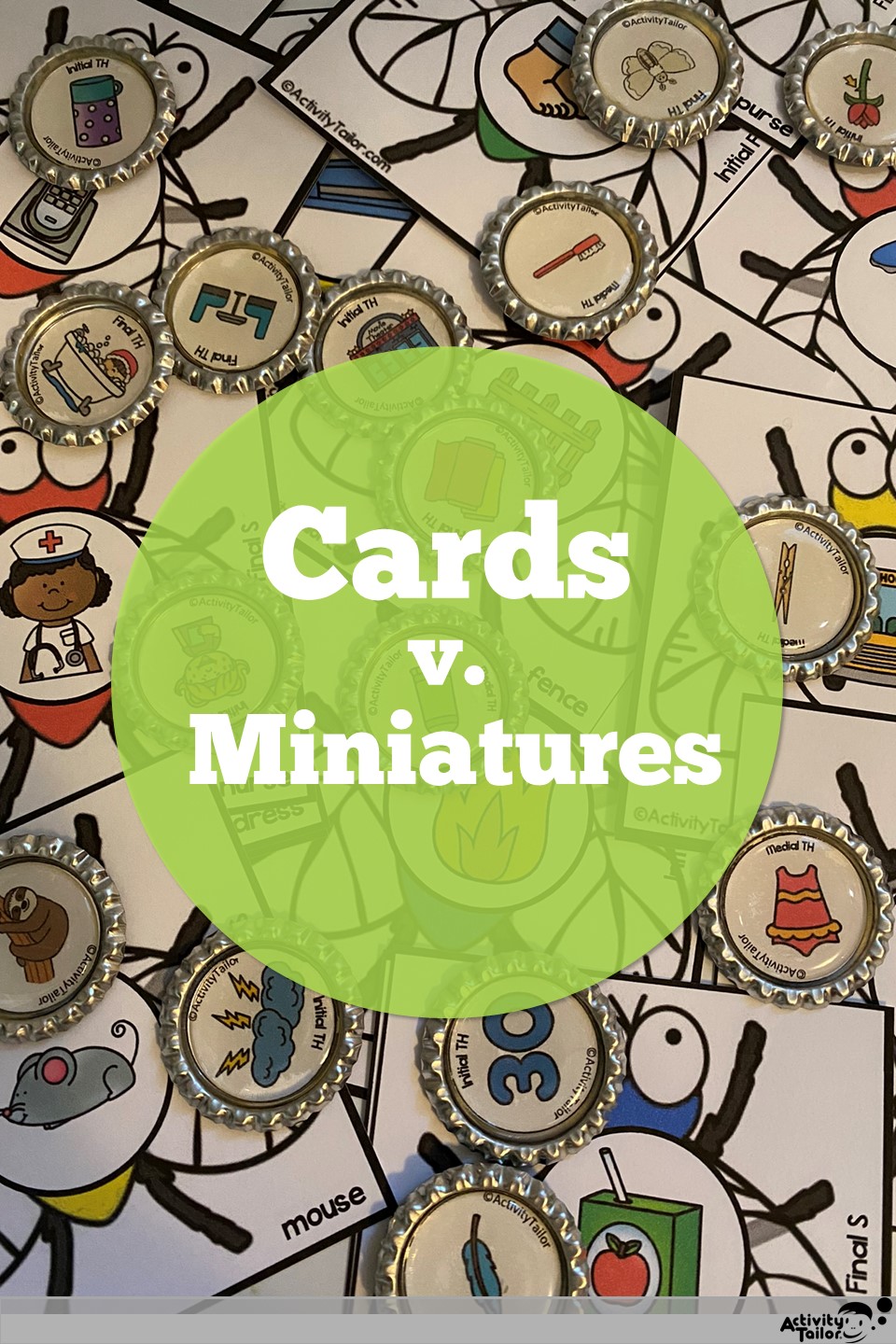
Miniature Objects vs. Picture Cards in Articulation Therapy
Where do you fall in the debate over using miniature objects vs. picture cards in speech sessions? Most SLPs have a definite preference for one. There are a few (like me!) who tend to drift back and forth depending on the child or the target. Let’s take a look at the pros and cons of using each in articulation based speech therapy sessions. Using miniature objects in speech Speech miniatures are so cute! You see the IG posts, and they look fun and engaging. They really are! But there’s a lot more to it than that. Pros Participation Miniature objects

Expectations for Speech Clarity
Parents are often confused by speech clarity guidelines especially when it comes to late talkers. If you can’t understand what your child is trying to tell you, isn’t that a clarity issue? Not necessarily. Late talkers are limited with how much language they have which means they struggle to communicate their wants, needs, and feelings. But there are other children who have language skills within expected ranges that are hard to understand because of they way they form their speech sounds. How do speech sounds develop? Many children don’t develop all mature speech sounds in the English language until they’re