Blog for Parents

Scissor Activities in Speech

Scissor Activities in Speech

Are you the type of SLP who is always up for a good craft, or does the idea of “art” make you sweat? Incorporating scissor activities in the speech room can be a way to bridge these two styles. Why work on scissor skills? Child development skills Scissor practice works on several childhood development skills, including bilateral coordination, eye-hand coordination and develops hand strength. The two most important to me as an SLP are bilateral coordination and hand strength. Bilateral coordination Bilateral coordination is the ability for our brain to use both sides at once. This not only helps with
Read More »

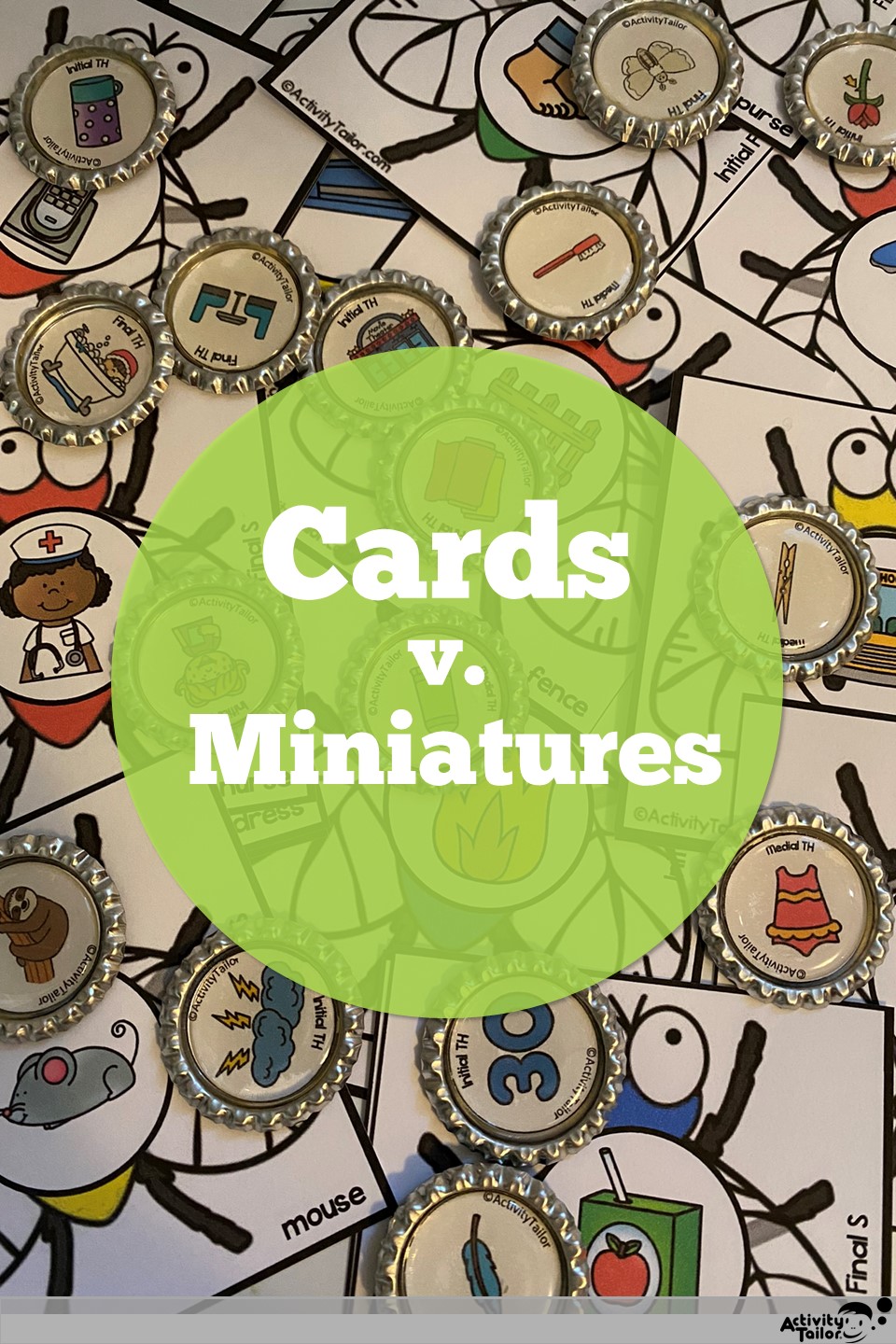
Miniature Objects vs. Picture Cards in Articulation Therapy

Where do you fall in the debate over using miniature objects vs. picture cards in speech sessions? Most SLPs have a definite preference for one. There are a few (like me!) who tend to drift back and forth depending on the child or the target.  Let’s take a look at the pros and cons of using each in articulation based speech therapy sessions. Using miniature objects in speech Speech miniatures are so cute! You see the IG posts, and they look fun and engaging. They really are! But there’s a lot more to it than that. Pros Participation Miniature objects

Read More »
Expecations for speech clarity

Expectations for Speech Clarity

Parents are often confused by speech clarity guidelines especially when it comes to late talkers. If you can’t understand what your child is trying to tell you, isn’t that a clarity issue? Not necessarily. Late talkers are limited with how much language they have which means they struggle to communicate their wants, needs, and feelings. But there are other children who have language skills within expected ranges that are hard to understand because of they way they form their speech sounds. How do speech sounds develop? Many children don’t develop all mature speech sounds in the English language until they’re

Read More »
young girl holding book in speech

Using Books in Speech Therapy

Speech-language pathologists know using books is one of the BEST ways to build language, but are often quick to assign that task to caregivers. Our graduate school classes are great at telling us the “why” we should do something but tend to be weaker in the “how.” If you don’t get experience working with another therapist who incorporates books into the therapy room, it’s easy to feel a little uncertain as to how to do it. The challenges of using books in speech therapy It takes a looong time. Most story books are long especially if they are designed for

Read More »
happy girl on slide action word

Why Action Words are Important

The role of verbs in language development The first words children say are almost always labels for common (to them) objects or people. Makes sense, right? It’s easier to attach meaning to a noun especially one that we have a lot of experience or interaction with. As little ones start building their vocabulary, you’ll find they move on to a wider variety of words. Social words/greetings: These are words like “hi” and “bye” and ones that go along with social games like “peek-a-boo” (even if it’s shortened to just the “boo”). Verbs: These begin as labels for actions like “jump”

Read More »
cute puppet for feed me game

Feed Me Games for Speech Therapy

“Feed Me” games for speech therapy are classics because they: are easy to set up engage kids for a long time While they are most often used for articulation trials, they can be used for a wide range of language goals too. Ready to add a “feed me” game to your speech therapy room? Let’s get started! What you need At it’s most basic, you’ll need something that “eats” and food to feed it, but that leaves space for a lot of creativity! As an Amazon affiliate, I may receive a small commission if you purchase products through my links.

Read More »
cute child saying first word

What counts as a first word?

Parents are often surprised (and relieved) at our first meeting when I let them know that a lot of the communication their child is attempting does count as a first word. What counts as a first word? A word is any consistent, and generally unique label, for a specific object, person, action, etc. Here are a few things that count: Exclamations Environmental and animal sounds Signs Vocal approximations Exclamations: These are some of the first words little ones pick up because they are usually said with a lot of emphasis and intonation. These include “uh-oh” and “ow!” Environmental and animal

Read More »
sandcastle with ocean themes in speech therapy label

Ocean Themes in Speech Therapy

When you think ocean themes in speech therapy are you assuming it’s for those of us who see students in the summer? It’s time to reconsider! Ocean themes cover a wide range of activities which means an even wider range of speech and language goals to target. Related themes or titles: Sea creatures Under the Sea Speech on the Beach Sharks Pirates A visit to the Aquarium Speech rooms love pirate themes in September to tie in with Talk Like a Pirate Day! Books with an Ocean Theme Links to purchase books may contain Amazon affiliate links. I receive a

Read More »
toddlers playing near each other

5 Types of Communication Intents

Early language is more about communication intents than vocabulary. Let’s take a look at 5 types we see in early language. Requests When little ones need support with language skills, we tend to focus on requests. This is because: They’re usually very motivating They’re naturally reinforcing It’s easier to set up situations that encourage these interactions They make our days more manageable “Late talkers” have more frequent and bigger tantrums because they’re frustrated by their lack of language (aka their ability to tell you what they want). Helping them learn to express their wants and needs can decrease these outbursts.

Read More »
collage of moms playing with their children

What is your parenting play style?

We all have different interests and different ways of learning. We can use these to find our parenting play style so we enjoy the activities we do with our kids as much as they do! For a quick, free quiz with suggestions for activities you’ll love, click here. Activities based on parenting style: Creative types love messy, hands-on projects. Try arts and crafts, cooking with kids, and sensory bins! You might also like dramatic play like dress-up and creating performances. Active types are ready to go when it comes to sports and other physical activities. You can try children’s sports

Read More »
boy popping out of a box titled pop-up words

Understanding Pop-Out Words in Speech and What They Mean for My Child

Is there anything more frustrating than hearing a word a couple of times from your child and then IT DISAPPEARS?! Where did it go?! These words are referred to as “pop-out words”. They are a very normal occurrence for little ones whether they’re on track with their speech and language development or a bit behind.  Let’s talk more about understanding these pop-out words in speech and what they really mean for your child.  More about Pop-Out Words The phrase “pop-out words”, coined by Pam Marshalla, refers to when a child says a word clearly on occasion but doesn’t say the

Read More »

Does Your Child Repeat Everything? They Might be a Gestalt Language Learner!

Does your child repeat words and phrases? Maybe common things you say or lines from their favorite song or show? Do the words or phrases sometimes feel out of place? Even though they repeat, does it feel like your child doesn’t repeat when you ask them to? Your child might be a gestalt language learner!  What is Gestalt Language Learning? Gestalt language learning is a style of language learning that starts with repeating phrases and ends with making new, spontaneous speech.  Unlike most children who learn to communicate starting with single words, gestalt language learners acquire language through chunks called

Read More »

How to Help Your Child Learn to Share and Why They Aren’t Already

Share, please share, share. You likely say this often to your little one. But why? And why don’t they understand? Teaching little ones how to share can feel like such a challenge. Let’s chat about why this is often the case and how you can help teach sharing to your toddler or preschooler. Why is Sharing Important? Sharing promotes compromise and fairness. It is vital for developing lasting friendships, cooperating with others, learning how to wait, negotiating skills, and managing feelings of disappointment.  Sharing back and forth in play also sets the stage for the back and forth style of

Read More »
autistic boy playing with play dough

Embracing Neurodiversity in Speech Therapy and Beyond 

Embracing neurodiversity in speech therapy and life choices is vital for providing the best support possible for neurodivergent children.  The term “neurodivergent” is an umbrella term that encompasses Autism, ADHD, dyslexia, and other diagnoses. Neurodiversity essentially is the concept that some individuals’ developmental pathways develop differently than the majority of the population (referred to as neurotypical persons). This term acknowledges the diversity of the human race and each individual person.  With neurodivergence in mind, one should consider neurodiversity-affirming language and approaches to selecting therapy and strategies in therapy.  First thing’s first: neurodiversity-affirming explained The main idea behind being neurodiversity-affirming is

Read More »
young boy with autism building with blocks

Recognizing the Early Signs of Autism

You know your child best. You’ve watched each amazing thing he’s done and listened to all the sounds he has made (or maybe not made). You already know how special he is, but you also know in your gut that he is different. You might be seeing early signs of Autism. Recognizing the early signs of Autism are important for current and future success for your child.  What is Autism? Autism Spectrum Disorder (aka Autism) is a neurodevelopmental difference. An autistic person’s brain develops differently than that of a neurotypical person.  There is no single cause of Autism but instead

Read More »

An SLP’s Response to Parent Concerns about Bilingualism and Speech Development

Many parents are concerned about the impact of bilingualism and speech development for their child.  What is bilingualism? A person is bilingual when they speak two languages.  Speaking two languages is even possible for young children! A child may be bilingual by learning two languages at once or by learning a second language after they have begun learning their first.  Developmental Information for Bilingual Children First Words Just like monolingual children, most bilingual children speak their first words by the time they are 1 year old and use two-word phrases by the age of 2. Mixing Languages Children may mix

Read More »
Child learning the basics of AAC

The Basics of AAC in Speech Therapy

Let’s chat about the basics of AAC in speech therapy! What is AAC? AAC stands for “alternative or augmentative forms of communication”. According to the American Speech-Language-Hearing Association, AAC is all the ways a person communicates besides speaking verbally. AAC encourages greater independence, increased communication, and more social interactions for many individuals. When a little one isn’t talking, it’s not uncommon for a therapist to suggest a form of communication other than talking. This doesn’t mean they’ve given up! Or that talking is no longer a priority! The most important goal is to give our children LANGUAGE. Once they understand

Read More »
therapist evaluating a child's language skills

What to expect from a speech and language evaluation

What can you expect from a speech and language evaluation with a toddler or preschooler? Whether you finally got the referral you’ve been asking for or received a referral you didn’t expect, let’s take a look at what you can expect for your late talker on evaluation day. Before you go You may receive paperwork ahead of time including a release of information form. This allows the speech-language pathologist to share findings with other family members, schools or professionals. It is always your choice as to who has access on your child’s development. If you aren’t sure you’re ready to

Read More »
Sample of a toy rotation

How to Increase Your Child’s Attention Through Toy Rotation 

Do your kids seem easily bored despite a million toy choices?  Does your little one drift from activity to activity, but doesn’t settle down with any of them? Are you constantly overwhelmed by stuff?  Try toy rotation!   Oftentimes, littles ones are overwhelmed by the number of toys at their disposable, rather than bored. By limiting the number of toys available to a child at one time, you will promote deeper, more creative play and help expand attention skills!  How does toy rotation work? Rotating toys involves presenting a limited number of toys to a child. The set of available toys

Read More »
How to teach body parts mr. potato head

Teaching body parts

Teaching children body parts develops vocabulary, but it also helps with confidence and positive self-image. Children start identifying basic body parts like “nose” around a year. More specific words like “wrist” and “knee” are mastered around age five. Let’s look at some activities we can use to work on this classic language goal. Activities may contain Amazon affiliate links. Bathing baby dolls A shallow bin of water, a baby doll and a washcloth are all you need for some splashing fun! (Oh, maybe add a towel beneath the bin.) Label all the parts of baby that you are cleaning, but

Read More »